
2025 Investment Report: Growing Our Poverty-Fighting Impact

The Constellation Fund uses data and evidence to identify investments that improve lifelong health and earnings for our neighbors. Our latest Investment Report highlights what our portfolio of grantees achieved in the fight against poverty across the Twin Cities — and why 2025 marks our most productive year to date.
Social Investing
At Constellation, we treat every philanthropic dollar like an investment. The returns we measure are lifetime improvements in the actual health and earnings of our neighbors struggling with poverty.
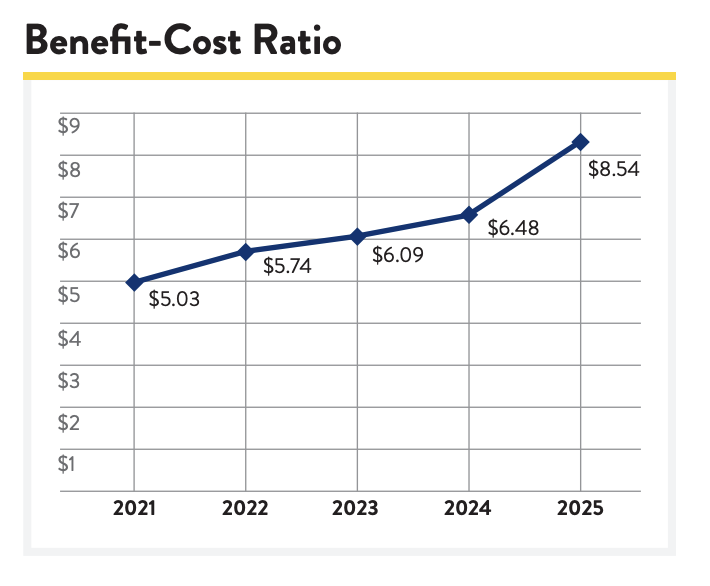
This year, our portfolio achieved a record benefit-cost ratio (BCR) of $8.54. In plain terms, that means for every dollar donated through Constellation, we estimate roughly $8.54 in measurable income and health benefits flowing to participants. Those benefits start materializing fast — it takes only 15 months to flip to a positive social return on investment. Our portfolio generated an estimated $33.9 million in total impact in 2025, and our grantees impacted more than 250,000 people in the Twin Cities who experience measurable improvements in their lives.
What’s remarkable is the trajectory. When we started in 2021, our benefit-cost ratio was $5.03. It has grown consistently each year to where it is today. That reflects our team’s ongoing refinement of how we evaluate organizations and how we allocate capital — concentrating dollars where the evidence shows the strongest returns.
Consider one of our grantees as an example: American Indian OIC. Their Takoda Institute offers career training that leads to industry-recognized credentials — in phlebotomy, commercial driving, tech support, and more. When a participant earns one of those credentials, it opens the door to higher wages that compound over years. That’s the kind of growth our benefit-cost ratio captures: real, lasting economic mobility for people in our community.
Or consider Ready, Set, Smile, a Constellation grantee providing oral health education and dental treatment to children across 63 partner sites in the metro. This is a health intervention, but it’s also economic. Better oral health as a child translates into better long-term health outcomes. Health interventions collectively represent $93.8 million in benefits across our portfolio — the second-largest category of impact we track.
More Impact, Less Risk
These examples aren’t outliers. They represent exactly what our model is designed to find: organizations executing efficiently, backed by strong evidence, and creating the most measurable value per dollar for participants. And not only does our portfolio deliver a great return but it does so with remarkable stability. Each donated dollar through Constellation is roughly three times more risk-efficient than a dollar given without this kind of rigorous impact data.
Of course, we’re working hard to continue to improve how and what we measure. Some critical areas — housing in particular — are genuinely hard to measure. Housing benefits accrue over decades, and they’re correlated with many other factors, meaning isolating the impact is a challenge. Fortunately, CoLab, Constellation’s research-funding arm, is investing in the kind of longitudinal research that can fill in those gaps. Constellation is committed to following the evidence, even when it takes time to develop.

Meeting the Moment
If there’s one takeaway I’d leave you with, it’s this: Philanthropy doesn’t have to be a leap of faith. When you direct capital with evidence and rigor, the impact is not only higher — it’s more predictable, more transparent, and ultimately more respectful of the people it’s meant to benefit.