

CoLab

Pass the Mic: Listening to Community Wisdom
CoLab awarded its first research grant to Research in Action, a Minneapolis-based research and evaluation group, to conduct Pass the Mic- a systematic study that asks Minnesotans living in poverty what they need for long-term thriving. This collaboration represents a brief and important departure from CoLab’s focus on examining long-term program impacts, instead prioritizing community voice to ensure future investments align with the priorities and needs of those most affected by poverty.

Research in Action engaged over 500 people across Hennepin, Ramsey, and St. Louis counties with current or past experience of poverty, focusing on young adults aged 18-24 and parents of children under 11. The study’s notable methodology involved a Community Action Council of 10 people directly impacted by poverty who co-developed the survey questions alongside researchers
The findings challenged conventional wisdom.Participants described poverty not merely as financial scarcity, but as “a web” encompassing limited opportunities, psychological impacts, and systemic barriers.
“Thriving is being able to think about what’s ahead instead of being stuck in now; having the freedom to take chances to better your life without fear of falling flat.”
– Pass the Mic Respondent
The study produced 11 concrete recommendations, including investing in direct services like housing and childcare, implementing peer support programs, and pairing financial assistance with education. Participants identified monthly direct cash assistance payments of at least $1,000 for minimum two-year periods as important for creating genuine pathways out of poverty.
These findings are already informing Constellation Fund’s grantmaking and provide a community-driven roadmap for moving beyond good intentions and toward transformative, evidence-backed solutions.
Wallin Scholars: Evaluating Comprehensive Post-Secondary Support
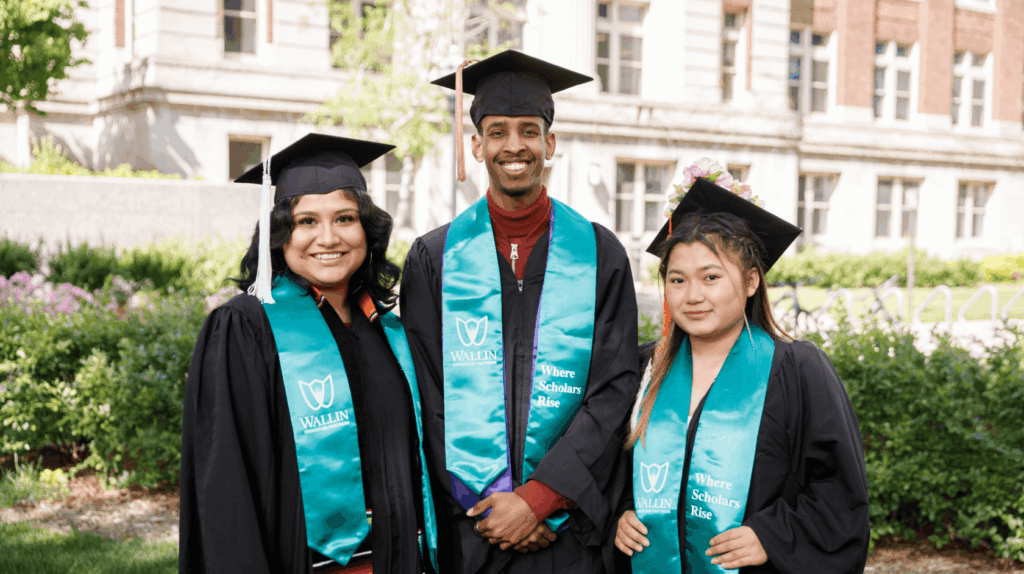
CoLab awarded its first longitudinal impact evaluation grant to MDRC to conduct a rigorous seven-year study of the Wallin Scholars Program. MDRC is a non-profit organization dedicated to improving the lives of people with low incomes through high-quality research and evidence. The evaluation examines whether comprehensive support for low-income students creates upward mobility pathways through post-secondary education.
The Wallin Scholars Program supports students through two pathways: two-year scholarships for community college or four-year scholarships for institutions across the Midwest and Historically Black Colleges and Universities. The program combines financial aid with individualized academic advising and expanded career opportunities.
Research Program Overview
While existing evidence shows some programs improve college completion, few studies track participants long enough to determine whether educational gains translate into economic mobility. MDRC’s study will follow students for years beyond their college experience, measuring whether outcomes like enrollment and completion lead to improved employment, income, and upward mobility. The research will assess and compare two cohorts: high school seniors who receive Wallin Scholars support and those who navigate college without that support. As of this summer, the MDRC team is on track to enroll approximately 1,600 high school seniors across two cohorts over the fall of 2025 and 2026.
One Minnesota Trust Youth: Cash Plus for Young Adults
In an exciting public-private partnership, the State of Minnesota is funding an innovative pilot program while CoLab funds the evaluation of the pilot to determine if the evidence supports scaling up the program. The One Minnesota Trust Youth Cash Plus pilot addresses young adult homelessness through direct cash transfers and peer-led supportive services. Funded by a $5.3 million state appropriation, Trust Youth is the largest “cash plus” study of this kind in the country.
Research suggests that providing flexible cash assistance can increase food security, promote financial stability, and improve physical and mental health. Trust Youth serves young adults aged 18-24 who experience homelessness and have been in foster care. Participants receive $1,000 monthly for 24 months plus a onetime $4,000 stipend. The innovative program pairs cash assistance with supportive programming delivered through coach and peer navigator teams, including financial counseling, housing navigation, and education and career support.
Research Design
Chapin Hall, a policy research center focused on children, youth and families, leads the longitudinal evaluation using a randomized assignment of 270 participants into intervention and service-as-usual groups. The study will follow outcomes for two years beyond the 24-month intervention period across multiple areas like housing stability, financial wellbeing, health, education, employment, and social support. The evaluation employs a quality improvement framework to provide ongoing feedback to continually strengthen the program.
Why It Matters
With more than 10,000 Minnesota youth and young adults experiencing homelessness in 2022, effective solutions are urgently needed. Few approaches to youth homelessness have been evaluated on a long-term basis. If successful, the cash plus model could inform smarter policy and budgeting while reducing reliance on expensive emergency services, breaking cycles of homelessness for families and young adults.